Company News
News
- Selection and use of pne···
- How to maintain the valv···
- What should be noted in ···
- Installation and removal···
- Valve maintenance
- Characteristics and use ···
- Valve maintenance knowle···
- Types of valve maintenan···
- Maintenance of key appli···
- Valve maintenance knowle···
Contact Us
Mob:15962631502
Email:yanxingshuai@163.com
Address:2299 Huanqing Road, Yushan Town, Kunshan City
Company News
Characteristics and use and maintenance of safety valve
Release time:2021-04-28 Click:374
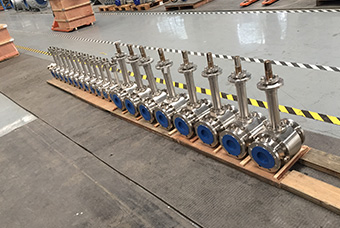
1、 Key types and structural features of safety valves:
The safety valve is a kind of fully automatic valve, which can be fully opened under the condition of overpressure of mechanical equipment, and discharge unnecessary substances, so as to ensure the safety of mechanical equipment. When the working pressure drops to the standard value, it can be fully closed and repaired, and prevent the further outflow of substances. There are many types of safety valve, the key is static weight type, rod type and spring type. Among them, the main use of spring type safety valve is more common. Here is a key introduction to spring type safety valve. As we all know, the tighter the spring is pressed, the greater the force is needed. In other words, the clamping force of the spring is positively related to the shape variable. With the increase of the height width ratio of the valve core opening, the reduction of the spring is also increased, and the recoil force is relatively expanded, which is just the force that the safety valve must bear in the work. There are many types of spring type safety valves. Nowadays, the key choice is cylindrical spiral, and the cross section of stainless steel wire is generally annular reducing spring. This kind of spring has typical linear bearing characteristics, which conforms to Hooke's law.
2、 Application, maintenance and common problems of safety valve:
Before installation and application, the safety valve should be adjusted to the required working pressure on the test bench, and the tightness of the safety valve should be checked. The adjusted and checked safety valve should be sealed. The safety valve in application should be maintained regularly, and checked on time according to the relevant safety production technical supervision technical specifications. The common faults of safety valve and the key ways to remove them are as follows:
1. Valve leakage: under all normal pressure of the valve, the protruding surface of the valve core and the high-pressure gate valve has leakage beyond the allowable level. Key reasons and solutions:
1) If the dirt falls into the convex surface, the valve can be opened several times with the lifting wrench to flush the dirt away.
2) Protrusion damage. According to the damage level, grinding or milling after milling should be used to repair in many aspects.
3) If the spring is loose, the setting pressure will be reduced and the valve will leak. The spring should be replaced or the screw of the extruder should be properly tightened.
2. Causes and solutions of valve opening and closing failure.
1) The adjusting ring should be adjusted properly to make the valve open for a long time or return to seat slowly, so it should be adjusted again.
2) Because the internal parts are jammed, it is likely to be caused by improper installation, dirt infiltration or parts erosion, etc., the cause should be found out and removed.
3) The resistance of the exhaust pipe is too large, and there is a large condensing type when discharging, so the resistance of the exhaust pipe should be reduced. 3. The safety valve jumps or flutters frequently. The key reasons are as follows:
1) The inlet pipe diameter is very small or the resistance is very large. The inner diameter of the inlet pipe shall not be less than the inlet specification of the valve, or the resistance of the inlet pipe shall be reduced.
2) The resistance of discharge pipe is too large. The resistance of discharge pipeline should be reduced.
3) If the adjustment circle is not adjusted properly, the working pressure of re seating is too high, so its position should be adjusted again. 4) The compression strength of the spring is very high, so the spring with suitable bending stiffness should be changed.
- >>:没有了!
- <<:Valve maintenance knowledge you don't know
Related products